
Quick answer: Your Bluehost cPanel password is the same as your main account password. To change it in Bluerock (the current interface): log in at my.bluehost.com, click your profile icon at the top right, select Security, then click Change Password. In the Legacy interface: Account menu → Passwords → Main Password. Webmail passwords and FTP passwords are separate and must be changed inside cPanel independently.
Bluehost has three separate types of password, and which one you need to change depends on what you are trying to access. Your main account password controls your Bluehost control panel and cPanel. Your webmail password is a separate per-email-address credential managed inside cPanel. FTP passwords are separate again.
This guide covers all three. Jump to the section that matches what you need:
- Locked out of Bluehost or cPanel: see “Forgotten Your Password?” or “Change Password in Bluerock/Legacy”
- Need to reset a webmail password: see “How to Change Your Bluehost Webmail Password” below
- Need to update an FTP password: see “How to Change Your Bluehost FTP Password”
Does Bluehost Use cPanel?
Yes. All Bluehost shared hosting, WordPress hosting, and WooCommerce hosting plans include cPanel. It handles file management, email accounts, MySQL databases, FTP, subdomains, and one-click software installs. Your main Bluehost account password and your cPanel password are the same single credential.
Two versions of the Bluehost interface exist, and knowing which one you have tells you where to find cPanel:
- Bluerock (newer accounts): The primary dashboard at
my.bluehost.comis called Bluerock. It is Bluehost’s own front end that wraps cPanel behind a friendlier interface. Go to Websites → select your site → cPanel to open the full cPanel in a new tab. Single sign-on means no separate cPanel username or password is needed. - Legacy dashboard (older accounts): The original Bluehost interface at
bluehost.comshows a cPanel link directly in the Hosting section. Click it to open your cPanel.
cPanel on Bluehost runs cPanel & WHM version 114 or later. If you access cPanel directly via your domain’s :2083 port (e.g. https://yourdomain.com:2083), use your main Bluehost account username and password to log in.
How to Access Bluehost cPanel: Login URLs
Before changing any password, you need to get into Bluehost cPanel. The login path depends on whether your account uses the new Bluerock dashboard or the legacy Bluehost control panel:
- Bluerock (new accounts): Sign in at my.bluehost.com, click Websites in the left menu, select your site, then click cPanel. Bluerock loads cPanel in a new tab using single sign-on, so no separate cPanel password is required.
- Legacy accounts: Sign in at bluehost.com, click your account name or the Hosting menu, then click cPanel.
- Direct cPanel URL: You can also go directly to
https://server.bluehost.com:2083, whereserveris your assigned server name (visible in Bluehost as your nameserver, for examplebox123.bluehost.com:2083). This requires your cPanel username and main Bluehost password.
On Bluehost, your main account password and your cPanel password are the same credential. Changing one changes the other. The sections below walk through how to change that password, reset a forgotten password, and manage separate passwords for webmail and FTP.
Forgotten Your Password?
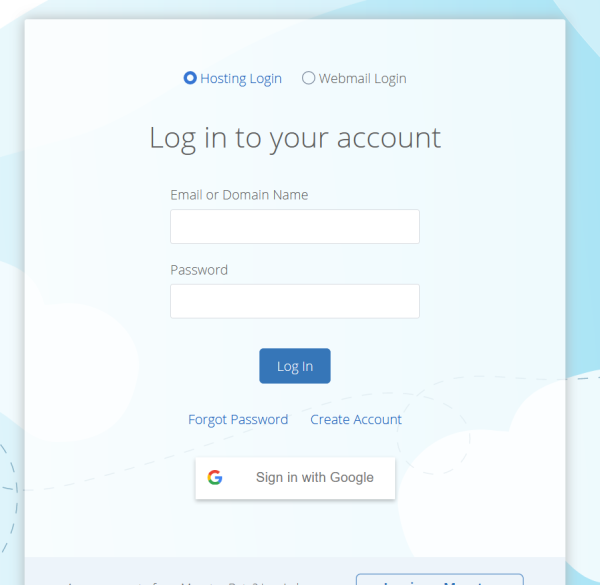
If you cannot log in because you have forgotten your password, go to the Bluehost login page and click “Forgot Password.” Enter your username, which is your full domain name, then click “Next.”
Bluehost sends a reset link to the email address on the account. The email may take a few minutes to arrive. Check your spam folder if it does not appear in your inbox.
If the email address on the account is no longer accessible, contact Bluehost support directly. Do not use the self-service reset flow in this case, it will only send to the email address on file. Bluehost’s 24/7 live chat agents can verify your identity using your account details (domain name, billing address, last four digits of payment method) and update the recovery email before sending a reset link.
How to Change Your Bluehost Webmail Password
Your webmail password is not the same as your main Bluehost or cPanel password. On Bluehost, each email account (such as [email protected]) has its own password, managed separately inside cPanel. Changing your main Bluehost account password does not change webmail passwords.
To change or reset a webmail password:
Step 1 - Log In to cPanel
Log into your Bluehost control panel and navigate to the cPanel section. In Bluerock, click “Hosting” in the left menu and then “cPanel.” In Legacy, cPanel is accessible directly from the control panel home.
Step 2 - Email Accounts
In cPanel, find the Email section and click Email Accounts. This lists all the email addresses set up under your domain.
Step 3 - Change Password
Find the email address whose webmail password you want to change. Click Manage next to it, then scroll to the Security section. Enter a new password and click Update Email Settings to save.
The new password takes effect immediately. Use it the next time you log in to webmail. Bluehost webmail supports Roundcube and Horde, both use the same email account password.
How to Find Your Bluehost Webmail Login URL
Bluehost webmail is accessible at https://mail.yourdomain.com or https://webmail.yourdomain.com. Replace yourdomain.com with your actual domain. You can also reach webmail by logging in to cPanel and clicking the webmail icon in the Email section, which takes you directly to the inbox selector without needing to know the URL.
If you cannot access cPanel because you are locked out of your main Bluehost account, reset the main account password first using the steps below.
How to Log In to Bluehost Roundcube Webmail
Bluehost webmail defaults to Roundcube on most accounts. Roundcube is a browser-based email client that lets you read, send, and manage email without setting up Outlook or Apple Mail. Here is how to access it and log in:
- Go to
https://mail.yourdomain.comorhttps://webmail.yourdomain.comin any browser. Replaceyourdomain.comwith your actual registered domain. - On the login screen, enter your full email address (e.g.
[email protected]) and the email account password you set in cPanel under Email Accounts. - If prompted to choose a webmail client, select Roundcube. You can set Roundcube as the default so you are not asked each time.
- Click Log In. Your inbox loads in the Roundcube interface.
The Roundcube login password is the email account password, not your main Bluehost account password. If you cannot log in, reset the email account password in cPanel: go to Email Accounts, find the account, click Manage, and use Change Password. The steps above under "How to Change Your Bluehost Webmail Password" walk through this exactly.
Roundcube vs Horde: Which Should You Use?
Bluehost offers two webmail clients: Roundcube and Horde. Roundcube has a cleaner, more modern interface and is the default for most accounts. Horde has more features (calendar, contacts, notes) but is slower and less frequently updated. For everyday email, Roundcube is the better choice. Both clients use the same email account password managed in cPanel.
Password Requirements
Before setting a new password, it must meet these Bluehost requirements:
- At least eight characters
- One capital letter
- One lowercase letter
- One number
- One special character (such as !, @, or #)
The new password cannot match any previous passwords and cannot include your account username. If these requirements feel restrictive, a password manager like Bitwarden or 1Password makes generating and storing a compliant password straightforward. Read our Bluehost review for an overview of what else is included in your account.
Change Password in Bluerock
Bluerock is the current default interface for new Bluehost accounts. Follow these steps:
Step 1 - Log In
Log into your Bluehost control panel using your current credentials.
Step 2 - Security Settings
Click the profile icon at the top right corner of the screen. Click “Security” in the submenu.
Step 3 - Change Password
Under “Main Password,” click the “Change Password” button. Enter a new password that meets the requirements above, then click “Create Password” to save.
Change Password in Legacy
If your account runs the Legacy interface, the steps are slightly different:
Step 1 - Log In
Log into your control panel using your current credentials.
Step 2 - Account Passwords
Click the “Account” menu at the top of the screen, then select “Passwords” from the submenu.
Step 3 - Main Password
Under “Main Password,” enter your new password and retype it to confirm. Click “Continue” to save.
What Else Does Changing Your Main Password Affect?
Your main Bluehost password controls your login and cPanel access, but it does not automatically update these separate credentials:
- Email account passwords (webmail): each email address ([email protected], [email protected]) has its own password managed in cPanel under Email Accounts. Changing your main password does not change these.
- FTP and SFTP passwords: FTP accounts have separate passwords set in the File Manager or FTP Accounts section of cPanel. If you use an FTP client to upload files, update those credentials separately.
- Database passwords: MySQL database users have their own passwords managed in cPanel. These are unaffected by a main password change.
This separation matters if you use SMTP to send email through Bluehost or connect apps directly to your database. Those connections continue working with their existing credentials after you change the main account password.
How to Change Your Bluehost FTP Password
FTP passwords on Bluehost are managed inside cPanel separately from the main account password. To change an FTP password:
- Access cPanel through your Bluehost control panel
- Go to Files → FTP Accounts
- Find the FTP username whose password you want to change and click Change Password
- Enter and confirm the new password, then save
Update your FTP client (FileZilla, Cyberduck, WinSCP, etc.) with the new password before reconnecting.
Enable Two-Factor Authentication
After updating your password, enable two-factor authentication (2FA) on your Bluehost account. With 2FA active, logging in requires both your password and a one-time code from an authenticator app. This blocks unauthorised access even if your password is compromised.
Find the 2FA option in your account Security settings (the same screen as the password change). Bluehost supports authenticator apps and SMS codes. An authenticator app like Google Authenticator or Authy is more reliable than SMS since SMS delivery can be delayed and is vulnerable to SIM-swapping attacks.
Common Reasons Bluehost Webmail Login Fails
If you cannot log into Bluehost webmail after resetting your password, one of these causes is usually responsible:
- Wrong URL: Bluehost webmail is at
https://mail.yourdomain.comorhttps://webmail.yourdomain.com. Not bluehost.com or any Bluehost login page. - Wrong username: Webmail requires your full email address ([email protected]), not your Bluehost account username.
- Wrong password: The webmail password is the email account password set in cPanel under Email Accounts, not your main Bluehost account password.
- Account suspended: If your Bluehost account is suspended for non-payment, webmail access is also blocked. Log into bluehost.com to check account status.
- Cached credentials: Your browser may be sending saved (outdated) credentials. Try an incognito window or a different browser first.
- Domain no longer points to Bluehost: If you moved your domain to another host,
mail.yourdomain.comno longer points to Bluehost’s mail server. Use your new host’s webmail instead.
Password Reset Not Working?
If the password change does not take effect or the reset email never arrives, try these steps:
- Check spam and junk folders, plus any email filtering rules that might block automated emails
- Enter your domain name as the username without https:// or www.
- Wait at least 10 minutes before requesting another reset link, as duplicate requests can cancel each other out
- Try a different browser or clear your cache if the new password is not accepted after saving
- If you changed your password but it still shows as wrong, log out completely and close all tabs before trying again, some browsers cache Basic Auth credentials that conflict with the new password
- Contact Bluehost’s 24/7 live chat support if none of the above works
Updating Your Email Client After Changing a Bluehost Webmail Password
Changing your webmail password in cPanel does not automatically update any email clients you have configured. If you use Outlook, Apple Mail, Thunderbird, or any other desktop or mobile app to check your Bluehost email, those clients will stop connecting and show authentication errors until you update the password in each app’s account settings.
This is the most common cause of “incorrect password” errors in email clients after a cPanel password change, and it catches a lot of people off guard because the change feels like it should propagate automatically.
Bluehost IMAP and SMTP Settings (for Reference)
When updating your email client settings, use these server values:
- Incoming mail (IMAP): Server:
mail.yourdomain.com, Port: 993, Encryption: SSL/TLS - Incoming mail (POP3, if used): Server:
mail.yourdomain.com, Port: 995, Encryption: SSL/TLS - Outgoing mail (SMTP): Server:
mail.yourdomain.com, Port: 465 (SSL) or 587 (STARTTLS), Encryption: SSL/TLS or STARTTLS - Username: Your full email address (e.g. [email protected])
- Password: The new password you just set in cPanel
Updating Password in Common Email Clients
Outlook (Windows): Go to File → Account Settings → Account Settings. Double-click the account. Update the password in the “Password” field and click Next. Outlook will test the connection and confirm the new credentials work.
Apple Mail (Mac / iPhone / iPad): On Mac, go to Mail → Preferences → Accounts, select the account, click Server Settings, and update the password under both the incoming and outgoing server sections. On iPhone/iPad, go to Settings → Mail → Accounts, select the account, and tap “Account” to update the password.
Thunderbird: Right-click the account in the left panel and choose Settings. Go to Server Settings and update the password. Thunderbird may prompt you for the new password on the next connection attempt, which is often the fastest fix.
Gmail “Fetch from another account” (Gmail import): If you set up Gmail to fetch from your Bluehost address using POP3, go to Gmail Settings → Accounts and Import → Check mail from other accounts, click “edit info” next to the Bluehost address, and update the password there.
After updating the password, send a test message to confirm outgoing mail works, then check that new incoming messages arrive. If the client shows a certificate error after the update (not just a password error), the mailbox may have been set up using a self-signed certificate path instead of mail.yourdomain.com. Re-entering the settings with the correct server hostname and port usually resolves this.
How to Find Your Bluehost cPanel Username
Your Bluehost cPanel username is separate from your email address and is the login credential required for the direct cPanel URL (https://yourserver.bluehost.com:2083). If you need to find it:
- Inside cPanel: Once logged in via Bluerock (my.bluehost.com → Websites → cPanel), look at the top right corner of the cPanel interface. Your username appears there next to your account name.
- Inside Bluehost control panel: In Bluerock, click your account avatar or name at the top right of my.bluehost.com. Under Account, look for “Account Information” or “General Info.” The cPanel username is listed there as your account username, separate from your email address.
- Contact Bluehost support: If you cannot log in at all, Bluehost’s 24/7 live chat can confirm your cPanel username after verifying your identity (domain name, billing address, last four digits of payment method).
Bluehost generates cPanel usernames automatically from your domain or email at signup, so the username is often not obvious. On most accounts it is between 6-8 characters and all lowercase. If you never use the direct cPanel URL (and instead always access cPanel through my.bluehost.com), you may never need the cPanel username directly.
Final Word: How to Change Bluehost cPanel, Webmail, and Email Passwords
Your main Bluehost password and your cPanel password are the same credential, so one change covers both. Your webmail password is separate: it is the individual email account password managed in cPanel under Email Accounts. FTP and database passwords are also separate and need to be updated independently. After any password change, enabling 2FA adds a meaningful second layer of protection to your account. While you are securing your account, also make sure you have a valid SSL certificate active. Here is how to set up SSL on Bluehost if you have not done so yet. Sign in at Bluehost to make these changes. If you decide not to continue with Bluehost, see the guide on how to cancel your Bluehost account and claim a refund within the 30-day window.