
Cloudways automatically backs up your server using an off-site system built on Amazon S3 storage. You can also enable local backups, take on-demand backups at any time, and schedule automatic backups on a frequency that matches how often your site changes. For teams that need an extra layer of redundancy, Cloudways also supports external backup to your own S3 or cloud storage bucket. Restoring from a backup is done from the same Cloudways dashboard where backups are managed.
Application Backup vs Server Backup on Cloudways
Cloudways has two levels of backup:
- Application backup: backs up a specific application (website) on your server. Found under the application’s Backup and Restore tab. Good for site-specific snapshots before making changes.
- Server backup: backs up everything on the server across all applications. Found under Server > Server Management > Backups. Covers all sites hosted on that server in one backup job.
For most use cases, enabling server-level backups is sufficient. Application-level backups are useful when you want a snapshot of a specific site before a major update or migration. See our separate guide on how to back up an individual application on Cloudways for that approach.
Off-Site Backup (Automatic)
Cloudways includes an automated off-site backup system using Amazon S3 storage for all servers. This backup runs automatically and cannot be disabled, every Cloudways server always has at least one recent backup stored remotely. The off-site backup is incremental, meaning only changed files are added after the first full backup, which keeps storage usage efficient.
How to Enable Local Backup and Take On-Demand Backups
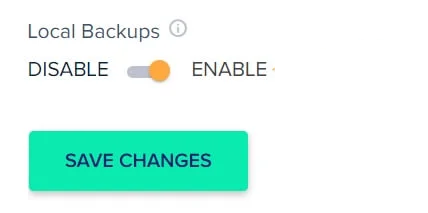
Local backups are stored on the server itself and give you faster access to recent snapshots. To enable them:
- Log in to your Cloudways account and go to Servers
- Select the server you want to back up
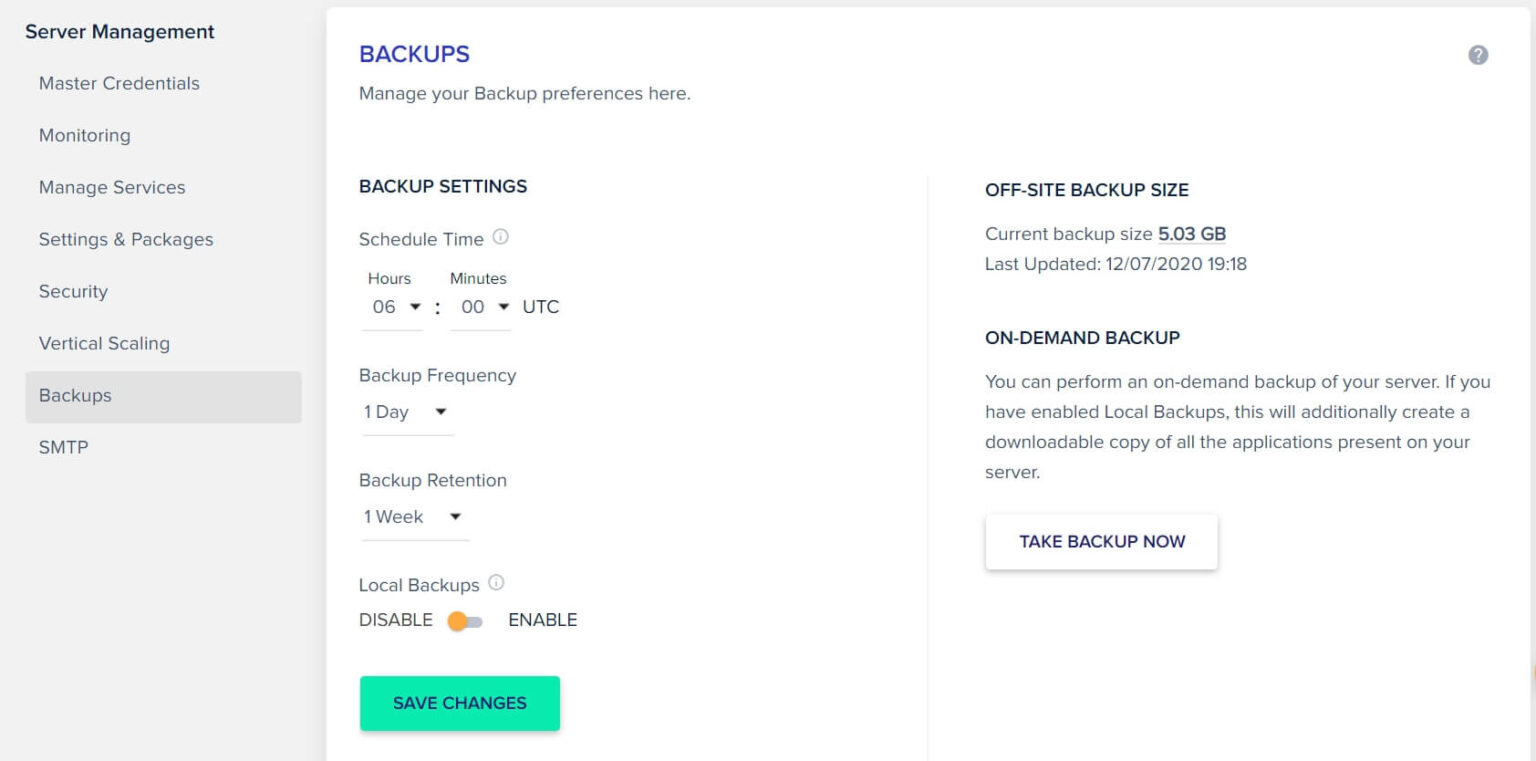
- Click the Server Management tab, then select Backups
- Toggle Enable Local Backup to on
- Click Save Changes
Once enabled, you can take an immediate snapshot by clicking Take Backup Now in the On-Demand Backup section of the same page. This creates a local backup at that moment, regardless of your scheduled frequency. Use on-demand backups before making significant changes to your site, plugin updates, theme changes, database edits, or scaling your server to a higher resource tier.
Local backups are stored in a local_backups folder on the server. You can download them via SFTP using a client such as FileZilla, connect using the server’s IP and your Cloudways master credentials, then navigate to the local_backups directory.
Scheduling Automatic Backups
You can configure how often automatic backups run and how long they are retained. In the same Backups tab under Server Management, set:
- Backup frequency: from every 1 hour to every 7 days. For an active site with daily changes, hourly or daily backups are recommended. For a low-traffic site, weekly is usually sufficient.
- Backup retention: how many backups to keep, up to 4 weeks. Keep at least 3 versions so you can roll back past a single bad change.
External Backup: Storing Cloudways Backups to Your Own Storage
Cloudways includes an External Backup feature that lets you store backup copies in a cloud storage bucket you control. This is separate from the default off-site backup and is useful for compliance requirements, long-term archive retention, or teams that require backups to be stored independently of the hosting provider.
Supported external storage providers:
- Amazon S3: provide your S3 bucket name, region, and IAM access key/secret
- DigitalOcean Spaces: provide your Spaces name and access credentials
- Google Cloud Storage: provide your bucket name and service account key
- Any S3-compatible endpoint: custom endpoint URL and credentials
To set up external backup:
- Go to Server Management > Backups
- Click the External Backup tab
- Select your storage provider and enter the required credentials
- Set a backup frequency (how often Cloudways pushes a copy to your external storage)
- Click Save Changes
External backups are sent in addition to the built-in off-site backup, enabling external backup does not replace the default Cloudways backup system, it adds a second copy in a location you own. This is the most resilient setup for production sites where data loss is not acceptable.
What Cloudways Backups Include
Understanding what is and is not in a Cloudways backup helps you plan for complete disaster recovery:
What is included:
- All website files (WordPress core, themes, plugins, media uploads)
- MySQL databases for all applications on the server
- Email accounts and mail stored on the server
What is not included:
- Server-level system configuration files (OS-level settings, not application settings)
- SSL certificates, Let’s Encrypt certificates are re-provisioned on restore; custom certificates need to be re-uploaded manually
- The backup archive files themselves, backups are stored separately and are not nested inside each other
- Temporary and cache files, these are excluded to keep backup size manageable
If you are restoring to a completely different server (rather than the original), application settings that Cloudways manages at the server level (PHP version, NGINX config) need to be reconfigured. Application-level settings stored in the WordPress database are carried over in the backup.
How to Restore a Backup on Cloudways
Restoring an application-level backup is self-service: go to the application, click the Backup and Restore tab, select the restore point you want, and click Restore. Cloudways overwrites the current application with the backup. Take a fresh on-demand backup of the current state first if you are unsure, this gives you a way to revert the restore if something is not right.
Server-level restoration from the off-site backup (for example, a full server recovery after hardware failure) requires contacting Cloudways support. They can initiate a full server restore from the off-site Amazon S3 backup. For most site-level incidents, the application-level restore is faster and sufficient.
How Often Should You Back Up on Cloudways?
The right backup frequency depends on how often your site changes and how much data loss you can tolerate. Here are practical guidelines:
- Daily backups: Right for most WordPress sites with regular content updates, WooCommerce stores with daily orders, or any site where losing a day of data would require significant manual recovery.
- Every 6 hours: Right for high-traffic WooCommerce stores or membership sites with frequent user registrations and transactions. Losing 6 hours of order data is recoverable; losing 24 hours is a business problem.
- Weekly backups: Acceptable for static or rarely updated sites, such as a portfolio, landing page, or documentation site that changes only during deliberate development sessions.
- On-demand before changes: Always take a manual on-demand backup before any major plugin update, theme change, WordPress core upgrade, or code deployment, regardless of your scheduled frequency. This gives you a known-good restore point immediately before the change.
Cloudways allows backup frequencies as short as every 1 hour on the retention schedule. Set your frequency in Server > Server Management > Backups > Frequency.
Cloudways Backup Storage Limits
Cloudways does not charge separately for backup storage on its built-in backup system. The off-site backup included with every server is stored in Cloudways’ own Amazon S3-backed infrastructure at no extra cost.
The retention period is where limits apply. You choose how many backup copies to keep (from 1 to the maximum for your plan). More copies means a longer rollback window, but does not incur additional charges from Cloudways directly. The practical constraint is that Cloudways stores incremental backups, not full snapshots for each retention point, so storage growth is more gradual than it would be with full daily snapshots.
For external backup (to your own Amazon S3 or DigitalOcean Spaces bucket), storage costs are charged by the external provider at their standard rates. Amazon S3 costs approximately $0.023 per GB per month for standard storage, so a 10 GB site backed up externally adds roughly $0.23/month to your AWS bill.
Final Word: How to Back Up Your Cloudways Server
Backing up your server on Cloudways is straightforward: the off-site backup runs automatically, and local backups with on-demand snapshots give you full control over when you save a version. Enable local backups, set a schedule that matches your update frequency, and use on-demand backups before any significant site change. For production sites or compliance use cases, add an external backup destination, Amazon S3 or DigitalOcean Spaces, to keep an independent copy of your data. If you are running multiple sites on one server, a single server-level backup covers all of them. Before migrating a WordPress site to Cloudways, take a backup of the source first and set up scheduled backups on Cloudways once the migration is complete.